True (Cost) Prices in the Supply Chain of Coffee
The article by Jan Jansen True (Cost) Prices in the Supply Chain of Coffee: A Sustainable Supply Chain Finance View (free .pdf)
Published: 03.2026
Journal: London Journal of Social Sciences
DOI: https://londonic.uk/js/index.php/ljbeh/article/view/363
Summary of the Article
The article applies true cost concepts to a specific supply chain (coffee) using case studies and supply chain finance tools. It considers the coffee supply chain from Latin America to the Netherlands, focuses on SMEs (a case study of five Dutch SME coffee distributors), maps the entire supply chain (production → transport → packaging → consumption), supply chain finance (SCF) and the monetisation of environmental, social and economic externalities.
It estimates true (cost) prices using:
- Shadow pricing (supply-side externalities)
- Willingness‑to‑pay (demand-side valuation)
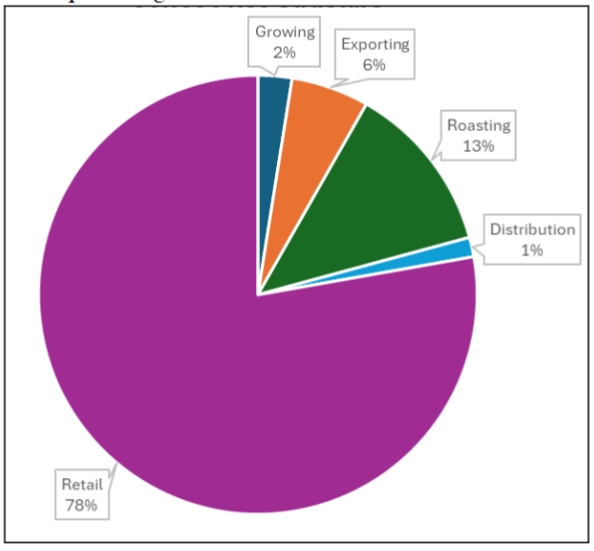
It highlights that farmers receive only ~2% of the retail price, which is neither a fair income nor sufficient to cover environmental costs.
The author states that monetising externalities is complex due to the many externalities but essential for true pricing.
Key points
1. True cost pricing in coffee supply chains
- Focuses on identifying the real economic, environmental, and social costs embedded in coffee production.
- Goes beyond market price to include:
- Environmental degradation (soil depletion, water use, carbon footprint)
- Social impacts (fair wages, working conditions, community well‑being)
- Long‑term sustainability risks (climate vulnerability, biodiversity loss)
2. Supply chain transparency
- Emphasizes the need for full visibility from farm to consumer.
- True cost models require:
- Traceability of inputs and processes
- Data sharing between farmers, traders, roasters, and retailers
- Standardized sustainability metrics
3. Sustainable Supply Chain Finance (SSCF)
- Explores how financial mechanisms can incentivize sustainable behavior.
- Examples include:
- Preferential financing for farmers who meet sustainability criteria
- Risk‑sharing models between producers and buyers
- Impact‑linked loans or credit lines
- SSCF aims to align financial flows with environmental and social performance.
4. Economic trade‑offs and value distribution
- Highlights imbalances in how value is captured along the coffee chain.
- True cost accounting can:
- Reveal hidden subsidies or externalities
- Show where margins are unfairly concentrated
- Support more equitable pricing models for farmers
5. Decision‑making based on true costs
- Encourages companies to integrate true cost data into:
- Procurement decisions
- Supplier selection
- Long‑term sustainability strategies
- Helps organizations shift from short‑term cost minimization to long‑term value creation.
Share this